

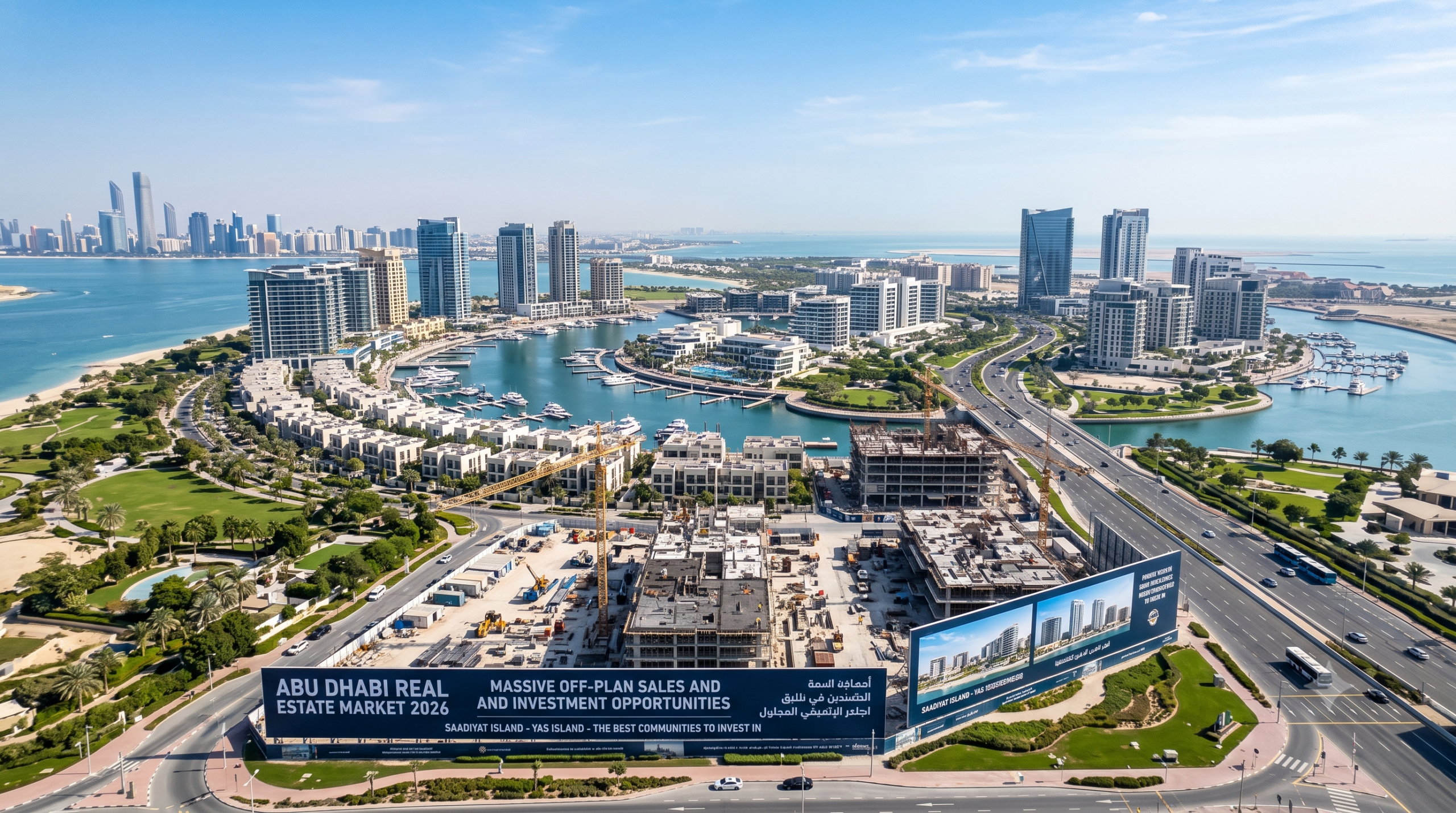
Abu Dhabi Real Estate Market 2026: Massive Off-Plan Sales and the Best Communities to Invest In
For a long time, the Abu Dhabi real estate market operated quietly in the shadow of its high-profile neighbor, Dubai. Global headlines and massive speculative capital heavily favored Dubai’s fast-moving skyline, while the UAE’s capital city was viewed as a conservative, slow-and-steady market primarily suited for local end-users.
That narrative has completely dissolved. The Abu Dhabi real estate market has officially broken free from historical trends, entering a massive expansion cycle of its own. Official data from the Abu Dhabi Real Estate Centre (ADREC) shows that the market hit a staggering record of AED 66 billion in total transactions in just the first quarter of 2026 alone—marking a phenomenal 160.7% year-on-year explosion in transaction value.
Even more eye-opening for international investors is that the off-plan segment captured a dominant 81% to 83% share of all residential sales activity. This represents a huge vote of confidence: global capital is betting heavily that Abu Dhabi’s future completion values will significantly outperform current launch prices. This comprehensive, long-form guide analyzes the macroeconomic forces driving the capital’s real estate boom, evaluates the dominant role of master developers, profiles the top investment zones, and provides a direct, data-backed comparison between Dubai and Abu Dhabi to help you optimize your portfolio.
Why Abu Dhabi’s Off-Plan Market Is Shaking Up the Industry
When more than four out of every five property transactions in a city are executed on properties that haven’t even broken ground yet, it means the market has underwent a major structural re-rating. This intense demand does not emerge out of thin air; it is built on deliberate, state-backed economic engineering.
1. Robust Regulatory Protections
The Abu Dhabi Department of Municipalities and Transport (DMT), via ADREC, enforces a highly strict regulatory framework that protects buyer capital. Similar to Dubai’s system, 100% of an investor’s off-plan milestone payments are legally locked inside specialized, project-specific government-monitored escrow accounts. Developers are legally barred from touching these funds until independent engineering inspectors physically verify that specific construction milestones have been achieved on-site. This zero-tolerance approach to development risk has given international cash buyers the absolute confidence to deploy millions into under-construction projects.
2. Extreme Scarcity in Premium Investment Zones
Unlike standard global cities that expand outward endlessly, Abu Dhabi’s primary luxury real estate is inherently constrained by its unique geography. The capital is a network of natural islands. Premium master-planned developments are taking place on finite islands like Saadiyat, Yas, and Ramhan. Once a specific island shoreline is fully built out, there is no more land to develop. Investors understand this natural scarcity; they are buying off-plan today because they know that waiting until project handover means competing for highly limited inventory on the secondary market at massive premiums.
3. A Massive Surge in Foreign Direct Investment (FDI)
The Q1 2026 data highlighted a spectacular 423\% explosion in individual Foreign Direct Investment, reaching AED 8.27 billion from buyers representing 99 distinct nationalities. International capital from the United Kingdom, India, Europe, and China is flowing into Abu Dhabi’s investment zones because the capital offers an elite taxhaven environment (zero income, property, or capital gains taxes) backed by a robust local economy driven by massive sovereign wealth fund deployments (via Mubadala and ADQ).
Aldar Properties: The Sovereign Core of Abu Dhabi Real Estate
You cannot successfully analyze or invest in the Abu Dhabi property market without understanding the central role of Aldar Properties. As the emirate’s largest, government-backed master developer, Aldar functions as the primary architect of Abu Dhabi’s modern urban landscape.
Financial Dominance and Near-Zero Developer Risk
For off-plan investors, developer insolvency is the ultimate risk. With Aldar, that risk is effectively minimized to near-zero. Backed heavily by Mubadala Investment Company, Aldar closed its recent audited financial cycles with a record-shattering AED 40.6 billion in group sales and an entry backlog exceeding AED 71 billion.
Those are not speculative marketing claims; they are audited public financial results reported directly to the Abu Dhabi Securities Exchange (ADX). Aldar’s massive cash reserves and institutional scale mean they consistently deliver mega-projects on time, to exact specifications, and with world-class infrastructure integration.
The Self-Sustaining Ecosystem Strategy
Aldar does not just build residential concrete blocks; they construct fully integrated, self-sustaining lifestyle ecosystems. When Aldar master-plans a community, they simultaneously build the Grade-A commercial office parks, the international mega-malls (like Yas Mall), the world-class entertainment venues, and top-tier educational institutions through Aldar Academies. By controlling the entire lifestyle infrastructure, they create built-in, permanent tenant demand, which directly translates into premium rental yields of 6% to 9\% for property owners.
Top Premium Investment Communities to Target
If you want to maximize your capital appreciation and yield potential in Abu Dhabi, your search should focus on three high-performance investment zones.
1. Saadiyat Island: The Global Cultural and Luxury Flagship
Saadiyat Island is Abu Dhabi’s crown jewel, designed to be an ultra-luxury oasis driven by global culture and pristine natural beaches.
- The Cultural Ecosystem: The island is home to the fully operational Louvre Abu Dhabi, with the massive Guggenheim Abu Dhabi, the Zayed National Museum, and the Natural History Museum all pushing heavily through their final construction phases.
- The Real Estate Math: Prices per square foot on Saadiyat are the highest in the emirate, yet on a global scale, they still sit roughly 30\% to 50\% below equivalent waterfront properties on Dubai’s Palm Jumeirah or in central London. Premium off-plan projects like Mamsha Gardens and the Baccarat Residences are seeing intense international demand, with average apartment prices climbing by over 15\% annually as the cultural district nears completion.
2. Yas Island: World-Class Entertainment and High-Yield Rental Velocity
If Saadiyat Island is dedicated to high culture and luxury, Yas Island is the undisputed capital of global entertainment, sports, and tourism.
                  THE YAS ISLAND DEMAND ENGINE

[F1 Grand Prix / Warner Bros / Ferrari World / SeaWorld] ➔ Massive Year-Round Tourist Inflow
                                                                       │
                    ┌──────────────────────────────────────────────────┴──────────────────────────────────────────────────┐
                    ▼                                                                                                     ▼
  [Short-Term Stay Premium]                                                                                             [Sticky Rental Demand]
  High-income holiday home yields                                                                                       Young professionals & expat families
Residential communities like Yas Acres, Gardenia Bay, and the Yas Golf Collection provide investors with incredibly versatile asset plays. Owners can easily pivot between lucrative short-term holiday rentals during peak tourist and racing seasons, or lock in long-term corporate tenants to achieve highly stable, consistent net yields of 7.5\%+.
3. Fahid Island & Ramhan Island: The Next Waterfront Frontier
For investors chasing early-stage, maximum capital growth upside, the newly launched waterfront island enclaves represent the ultimate strategic play. Projects like Fahid Beach Residences feature direct shoreline access, expansive open mangrove views, and low-density luxury villa footprints.
Because these islands are in their early development stages, their entry prices are heavily discounted compared to mature sectors on Yas or Saadiyat. Buying off-plan here allows investors to ride the exact same upward valuation wave that rewarded early buyers on Saadiyat Island five to seven years ago.
Abu Dhabi vs Dubai Property Investment: A Strategic Breakdown
The UAE property story is no longer a single-city narrative. To build a resilient regional portfolio, you must contrast the distinct operational advantages of both emirates:
| Investment Variable | Dubai Real Estate Market | Abu Dhabi Real Estate Market |
| Market Maturity Stage | Highly Mature; Globalized & Fast-Moving | Emerging Institutional; High Growth Room |
| Dominant Segment Volume | ~60% Off-Plan vs 40% Ready | 81% to 83% Off-Plan Dominant |
| Primary Capital Source | Heavily Entrepreneurial; Private International Cash | Sovereign-Backed Master Plans; Massive FDI Growth |
| Average Pricing Baseline | Higher Price per Sq. Ft.; Premium Luxury Focus | Lower Price per Sq. Ft.; Superior Entry Value |
| Rental Yield Stability | Highly Dynamic; Subject to Neighborhood Shifts | Highly Consistent; Anchored by Corporate/Govt Staff |
| The Golden Visa Pathway | AED 2M Equity; Highly Competitive Inventory | AED 2M Equity; Streamlined via Aldar/ADREC Track |
Conclusion: Portfolio Diversification is Essential
As we move through the second half of 2026, the data makes one thing crystal clear: ignoring the Abu Dhabi real estate market means missing out on one of the most secure, high-growth up-cycles in the Middle East.
While Dubai remains an absolute powerhouse for immediate, liquid ready-property yields and fast-paced urban lifestyle plays, Abu Dhabi provides a rock-solid, sovereign-backed alternative. By anchoring your capital to massive master developers like Aldar and securing prime off-plan assets inside restricted island investment zones like Saadiyat and Yas, you effectively position your portfolio to capture excellent capital appreciation on incredibly stable foundations.


Leave a comment